Eastern Sicily 7-Day Catamaran Route: Riposto to Syracuse Under Mount Etna
A 7-day east Sicily sailing itinerary by catamaran from Riposto to Syracuse, with Taormina, the Aci Trezza stacks and Ortigia.
Read more
Almost every Amalfi charter sails straight through the Punta Campanella reserve and most crews never realise it. The headland is the exact pivot point between the Sorrento Peninsula and Capri, so the moment you leave Marina Piccola or round the Capo and aim for the Faraglioni, you are inside a protected area with rules that carry real fines.
The trouble is that the official material is almost entirely in Italian, and the zone boundaries are not marked by buoys you can see from the helm. This guide lays out the punta campanella marine protected area rules in the way a skipper actually needs them: where you can drop the hook, where you must keep moving, and what it costs if a patrol boat decides you got it wrong.
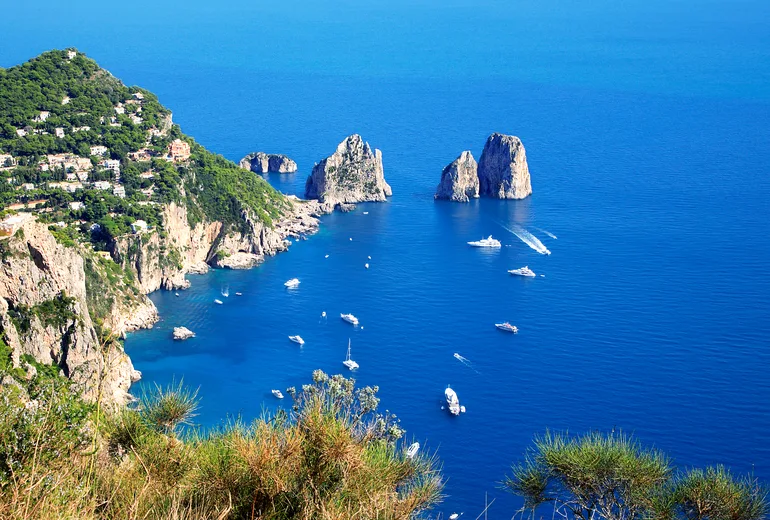
The Area Marina Protetta Punta Campanella wraps around the tip of the Sorrento Peninsula and spills into the waters off Massa Lubrense, Marina del Cantone and the gulf side toward Positano. It does not include Capri itself, but it ends only a couple of nautical miles short of the island, so the famous 3-mile hop across the Bocche di Capri clips the western edge of the park.
That matters because the channel between the mainland and Capri is one of the busiest stretches of water in the Mediterranean in August. Hydrofoils, day-tripper gozzi and superyacht tenders all funnel through it, and the reserve overlays the section closest to the Punta Campanella headland and the islet of Vivara’s neighbour, Li Galli. If your route runs Sorrento to the Faraglioni, you cross zone-controlled water for roughly half an hour.
The park uses the standard Italian three-tier system, and the difference between the bands is the whole game.
Zone A is the no-take, no-enter core. Around Punta Campanella there are two small Zone A pockets, the best known sitting right off the headland near the old tower of Minerva. No anchoring, no swimming, no fishing, no transit unless you are on an authorised guided dive. In practice you treat Zone A like a rock you steer well clear of. It is small, but patrols watch it closely because it is the easiest violation to photograph.
Zone B is where most of the good anchorages live, and it allows transit, swimming and anchoring with conditions. The key restriction is that you cannot drop on seagrass or rock where it damages the seabed, and on busy stretches you are expected to use the mooring buoys where they exist rather than your own ground tackle. Speed inside Zone B is capped — typically 10 knots, dropping to a slow crawl within 300 metres of the shore.
Zone C is the outer buffer and the most relaxed band. Anchoring and swimming are broadly fine, you still keep speeds sensible near the coast, and this is where the longer-stay anchorages around Marina del Cantone tend to fall. If you are unsure which band you are in, assume the stricter rule and you will rarely go wrong.
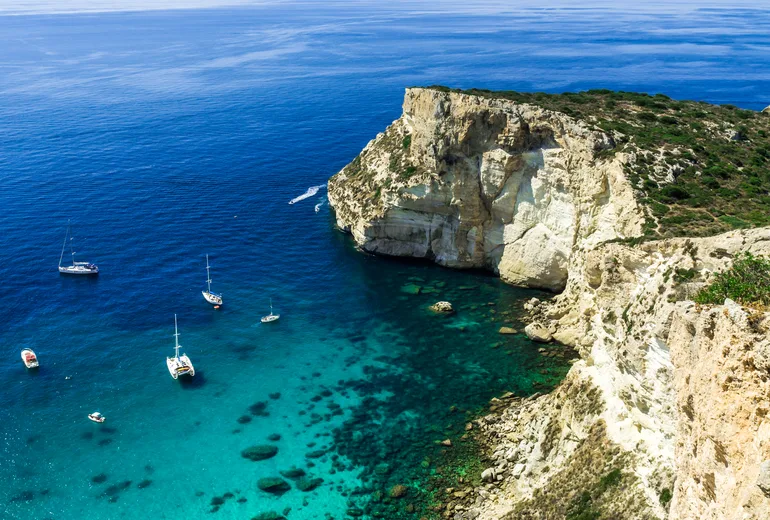
The standout stop is the bay of Ieranto, a deep horseshoe just east of the headland that ranks among the cleanest swimming water in the gulf. It is Zone B, so you anchor with care on sand patches, keep the speed right down on approach, and you are rewarded with a green-walled cove that the day boats can only reach by tender. There is no village, no beach bar, just water the colour of bottle glass and the ruins of an old tonnara on the shore.
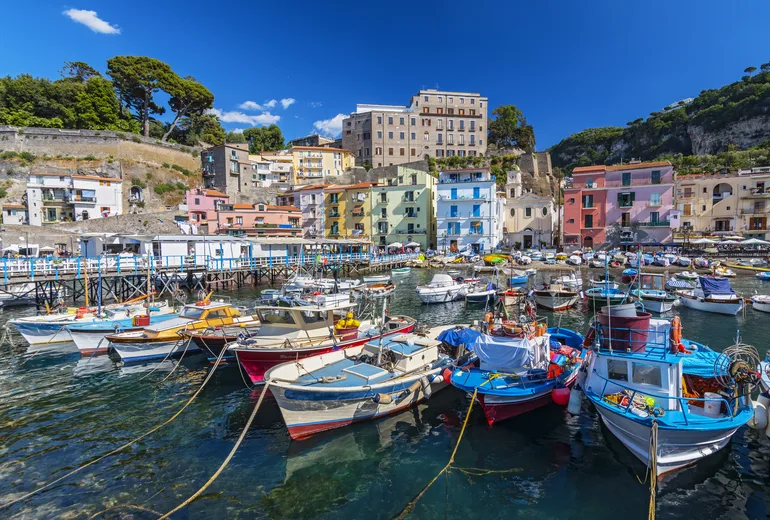
Further along, Marina del Cantone sits in Zone C and works as a lunch or overnight stop, with a shingle beach and a row of seafood places — Lo Scoglio is the famous one, where you tender straight to the jetty. Recommone, the next cove east, is quieter and just as clear. On the gulf side toward Positano, the waters off Nerano give you a settled anchorage when the prevailing breeze is from the northwest. Nerano is also where you order the dish the area invented, spaghetti alla Nerano with fried courgettes and provolone del Monaco, so a lunch stop here earns its place on the route.
Depth and holding vary across the bays, so a quick word on practicalities. Ieranto shelves steeply, and you often anchor in 8-12 metres on sand close in; Marina del Cantone gives you shallower, easier holding but fills with day boats by noon. The whole stretch is exposed to anything from the south, so in a sirocco you are better off retreating to the lee of Capri or back toward Sorrento. Most crews plan the reserve for a settled northerly day and keep the forecast open.
The unwritten rule on a catamaran is to use your raised helm position. From up there you can read the seabed far better than a monohull skipper can — pale sand to drop on, dark patches of Posidonia seagrass to avoid. We cover the seagrass question in detail in our guide to how to spot Posidonia and anchor legally in Italy, because it is the single rule most crews break here by accident.
Crossing the park under power or sail is allowed in Zones B and C, but two things will get you stopped. The first is speed: blast through at 18 knots and you are an easy target, especially the closer you are to the shore. The 300-metre coastal corridor is effectively a slow-speed zone, and the patrol RIBs sit just inside it. The second is the wake and noise from running tenders or jet toys inside the reserve, which is discouraged everywhere and banned in the inner bands.
Fishing of any kind needs care — recreational angling is restricted and often requires a permit even in the looser zones, and spearfishing is out across the park. If you have water toys aboard, keep the loud ones for outside the boundary. Most charter crews find the simplest approach is to treat the whole reserve as a quiet zone and save the speed for the open crossing to Capri.
This is not a place where a warning is the default. Anchoring on Posidonia inside a marine protected area falls under the national law that introduced penalties starting around €1,000 and climbing past €3,000 for repeat or serious damage, and the Punta Campanella park applies its own sanctions on top for entering Zone A, speeding, or fishing without authorisation. The Capitaneria di Porto and the park rangers both patrol, and in peak August they are visibly present off Ieranto and the headland.
In practice the crews who get fined are the ones who anchor on dark seabed in clear water where the violation is obvious from a passing RIB, or who cut the Zone A pocket to shave a few minutes. Stay on sand, keep buoy fields in mind, and slow down near the coast, and you will sail the reserve all week without a second look. Keep the charter paperwork and the boat’s documents to hand as well, since a routine stop usually ends in a friendly wave once the rangers see you are anchored properly and behaving inside the rules.
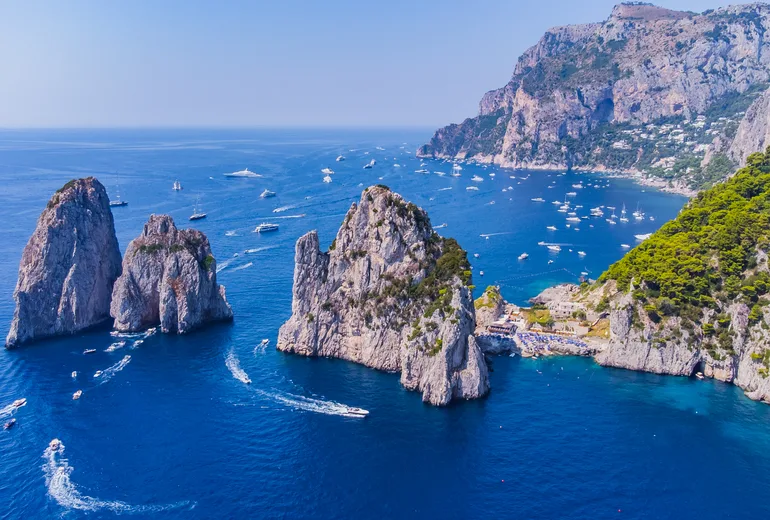
Punta Campanella is not a destination you set aside a day for — it is the water you pass through on the classic Sorrento-Capri-Positano triangle. A typical pattern is to leave Sorrento mid-morning, swim at Ieranto before the day boats arrive, lunch on the hook at Marina del Cantone, then time the crossing to the Faraglioni di Capri for the late afternoon when the tender traffic eases.
If you are building the wider route, our breakdown of the Naples to Capri seven-day catamaran route threads the reserve into a full week, and the companion piece on beating the Amalfi crowds by anchoring early explains why the dawn slot off Capri is worth setting an alarm for. For getting into the Grotta Azzurra itself, the private-boat guide to the Blue Grotto covers the timing that keeps you out of the worst queues.
No permit is needed to transit Zones B and C under sail or power, and free passage along the coast is allowed. Permits and authorisation come into play for guided diving, certain fishing, and any activity inside the Zone A core, which is closed to general boating.
You can anchor in Zone B and C where the seabed is sand and no buoy field requires you to use a mooring. Ieranto, Recommone and the coves around Marina del Cantone are the usual choices. Avoid dropping on seagrass, and check locally in high season, as some sand patches fill with mooring buoys you must use instead.
Penalties under Italy’s seagrass-protection rules typically start around €1,000 and rise into the thousands for serious or repeated damage, with the park adding its own sanctions for zone breaches. The reserve is patrolled in summer, so the risk of being caught on dark seabed is genuine.
Capri itself is outside the Punta Campanella park, which covers the Sorrento Peninsula side of the channel. The reserve ends a couple of miles short of the island, so the western edge of the Capri crossing brushes the protected water near the headland.
The bay of Ieranto, just east of the headland, has some of the clearest water in the Gulf of Naples and no road access, so it stays quiet. Anchor on the sand, swim before the tender boats arrive, and you get the cove largely to yourself.
Ready to build a week around the reserve? Browse our catamaran charter destinations across Italy and we will help you plan a route that threads Punta Campanella into the wider Amalfi and Capri loop.