Honeymoon Afloat: Amalfi Coast or Aeolian Islands for Your 2027 Sailing Honeymoon?
Amalfi glamour or Aeolian volcanic drama? A honest comparison of the two best regions for an Italy sailing honeymoon by catamaran.
Read more
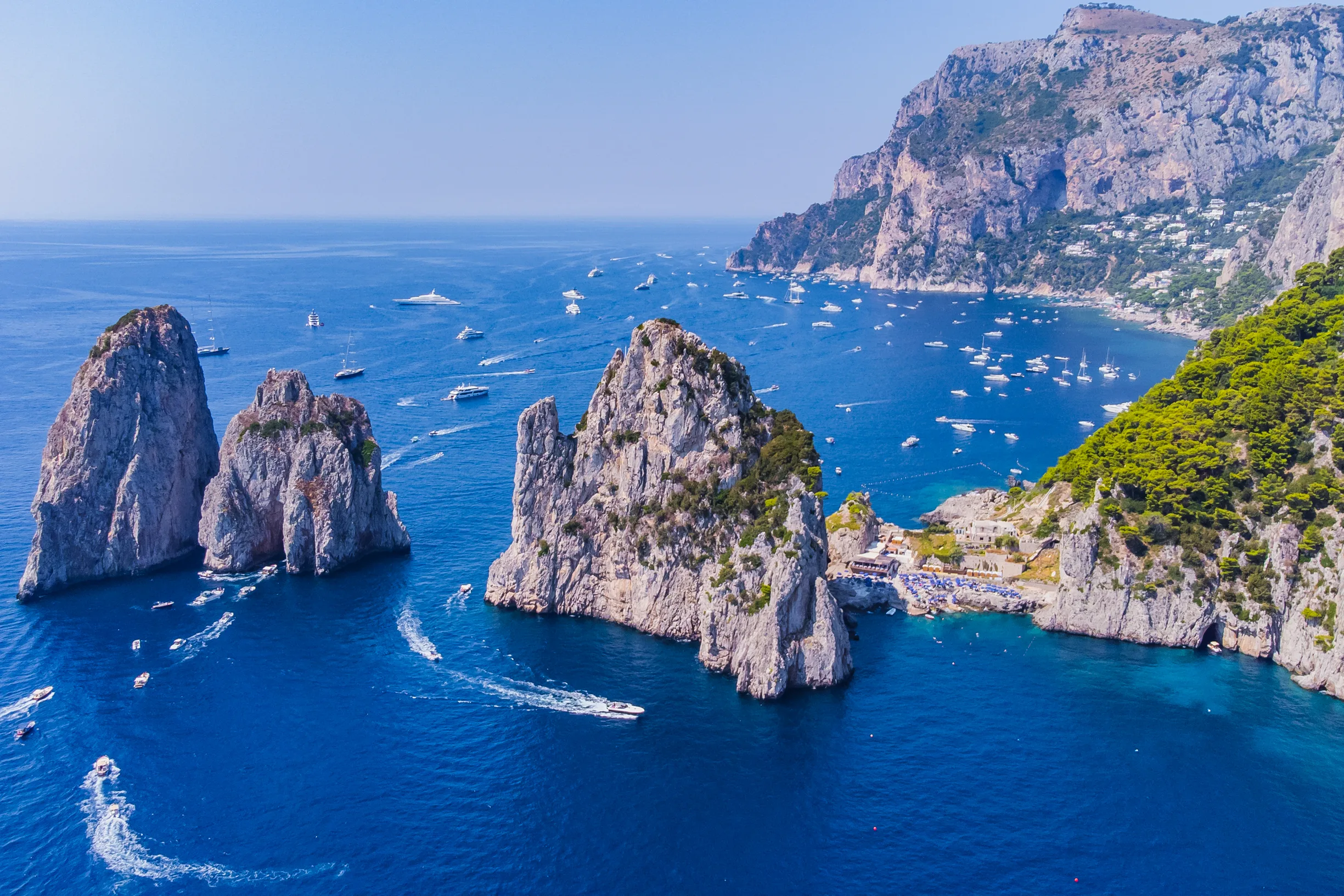
Everyone who books an Amalfi charter in July asks the same thing, and it boils down to how to avoid crowds on the Amalfi Coast by boat: how do you enjoy Capri and Positano when there are forty thousand other people doing the same? The honest answer is that you do not fight the crowd, you out-time it. On a private catamaran you control your clock, and the difference between a magical morning and a grim one is usually about ninety minutes.
This is the working playbook for beating the peak-season crush in high season. It is built around one principle: the day-tripper fleet from Sorrento, Naples and Salerno runs on the ferry timetable, and the ferries are predictable. Be anchored before they arrive, be moving when they pile in, and reclaim the famous spots in the early evening once they leave.
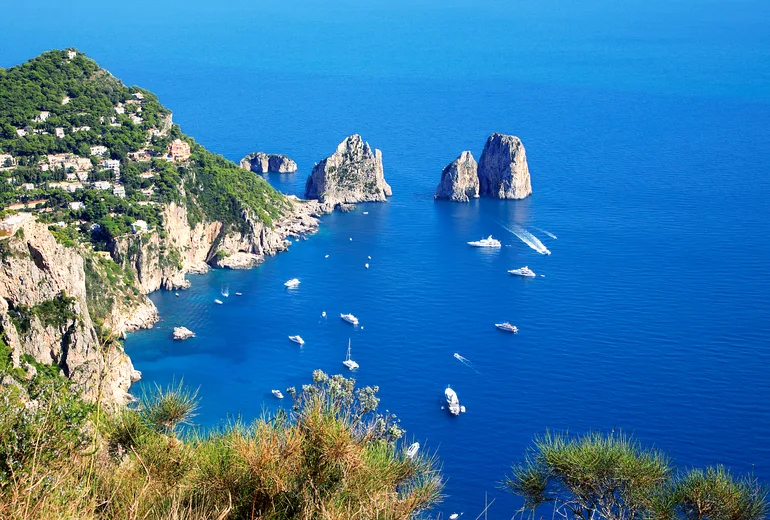
The whole approach to how to avoid crowds on the Amalfi Coast by boat comes down to one thing, and the Amalfi Coast and Capri have a rhythm in summer that makes it work. The first big ferries and excursion boats reach the Faraglioni and the Positano roadstead between roughly 10am and 11am, and the water stays packed until about 5pm. Outside that window, the same anchorages are calm and the light is better. A catamaran lets you live in those edges of the day because you sleep on board at anchor, so you are already in position when the towns are still asleep.
The other half of the equation is heat and wind. Mornings are typically glassy, which makes for easy anchoring and clear water; afternoons often bring a sea breeze and a building swell off the headlands. Reading that daily pattern is half the skill, and our regional notes on weather conditions for sailing the Amalfi Coast are worth a look before you set the alarm.
The single best move of the week is an early run to Capri’s Faraglioni, the three sea stacks off the island’s southeast corner. Lift the anchor wherever you spent the night, time the short hop so you arrive around 7:30am, and you will often have the natural arch of the Faraglioni di Mezzo almost to yourself. The water is still, the cliffs catch the first sun, and a swim through the arch at that hour is the version of Capri people imagine before they arrive in August.
By 9am, hold position only briefly, then leave. The first tour boats are inbound and the Marina Piccola side starts to fill. Rather than queue for a mooring you will not want by noon, point the bows away and let the crowd have it. If you crave the Blue Grotto, that is a separate operation with its own timing, covered in our guide to visiting the Blue Grotto by private boat.
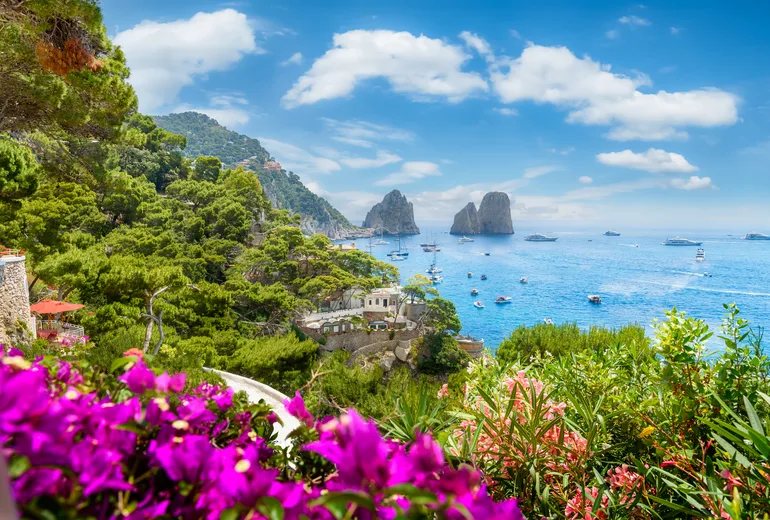
The deep water off the Faraglioni makes anchoring tricky, so most cats hold or pick up a day mooring for a short visit rather than settling in. For a longer swim stop, the lee of the island shifts with the wind: the Marina Piccola side works in a northerly, while the north coast toward Marina Grande shelters you from southerly breezes. Keep clear of the marked swimming zones and the hydrofoil channel into Marina Grande, which gets busy and impatient.
Once Capri and Positano fill, the smart play is to be somewhere else entirely. The mainland between Positano and Amalfi is lined with small coves and pebble beaches that the big excursion boats ignore because there is nothing to sell ashore. Marina di Praia, the narrow gorge below Praiano, is a good lunch anchorage with a couple of cliffside restaurants reachable by tender. Further east, the water below Conca dei Marini and the Furore fjord stays quieter than anywhere with a famous name.
This is where a catamaran’s shallow draft pays off. You can sit closer to shore than the deep-keeled charter yachts, find a clean sand patch, and put the swim ladder down while the headland keeps the swell off. Carry your own lunch and you skip the lunchtime restaurant scrum entirely. For a sense of what a full week stringing these stops together looks like, our Naples to Capri seven-day Amalfi route maps it out day by day.
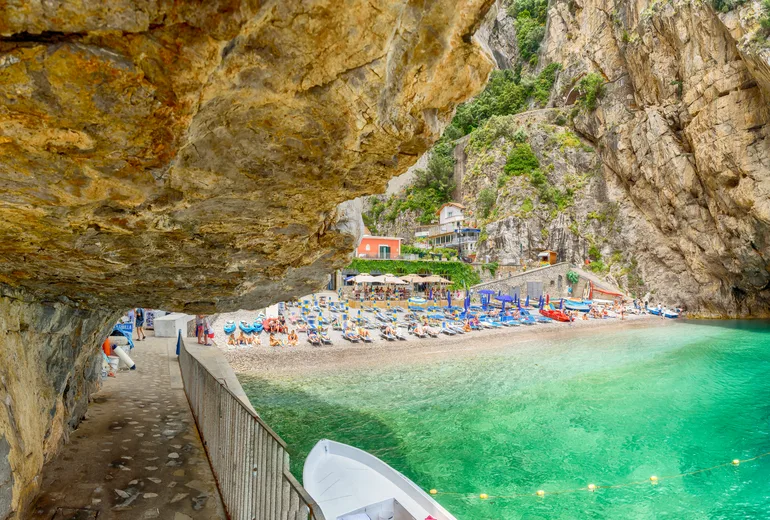
Beyond Praiano, look at the small bays under Conca dei Marini and the rocky inlets toward Cetara on the far eastern end, a working anchovy village that sees a fraction of Positano’s traffic. None of these have grand beaches, which is exactly why they stay calm at noon in July. Anchor on sand, watch your swing if the breeze fills in, and treat the lunchtime hours as your private window.
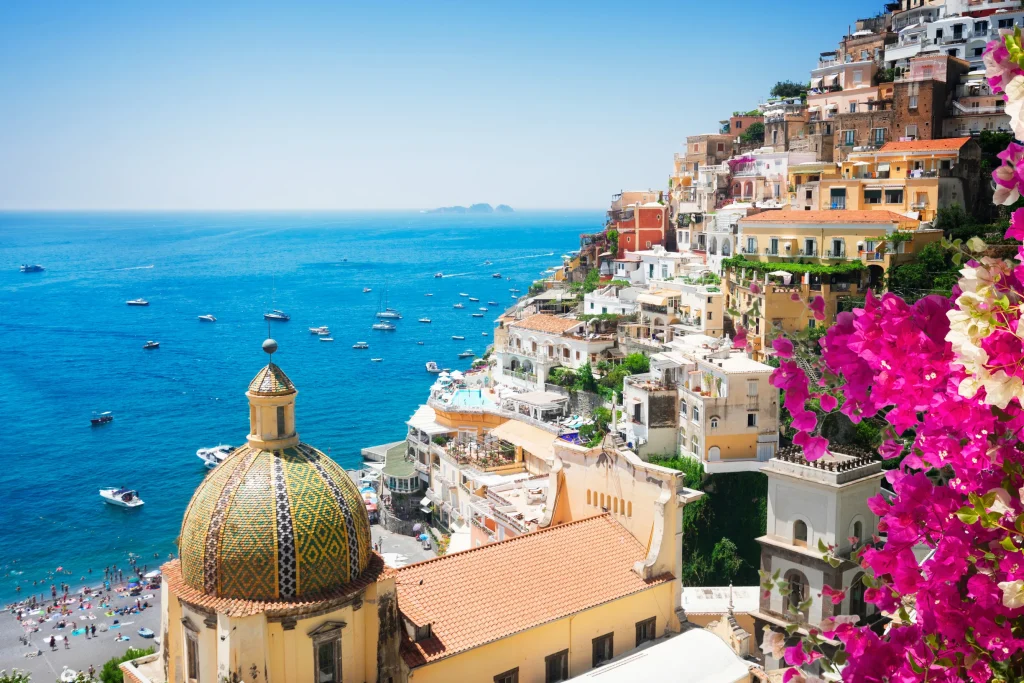
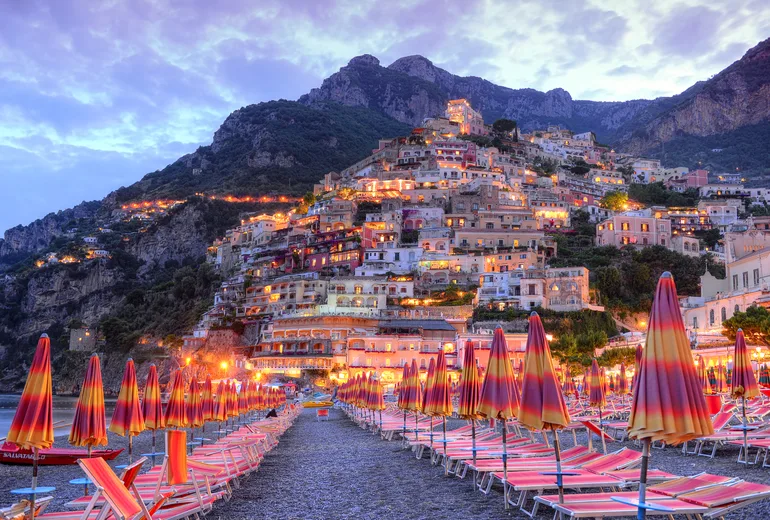
Around 4:30 to 5pm the day fleet starts its run home, and the coast exhales. This is the moment to ease back toward Positano. Anchor off the main beach as the afternoon glare softens, and the village shifts from a wall of bodies to the postcard it is supposed to be: the majolica dome of Santa Maria Assunta glowing, the cliffs going gold, the beach clubs folding their umbrellas.
Tender ashore for an early aperitivo if you want the town, or simply stay aboard and watch it from the water with a chilled bottle of Falanghina. Sleeping at anchor here, or just around the headland in a calmer cove, means you wake up already in position for tomorrow’s dawn run. That is the whole loop, and it is why a private boat solves the crowd problem that no hotel can.
A handful of details keep the plan smooth. Book a skippered cat if you are new to anchoring in deep, rolly water; the headlands here demand experience, and a local skipper knows which cove works in the day’s wind. Provision in Sorrento or Salerno before you start, because shopping in the small villages by tender eats your morning. Expect to use moorings rather than free anchoring in some controlled zones around Capri, and budget for them. And keep an eye on the afternoon sea state, as the run between Capri and the mainland can build a short, awkward chop by 3pm.
If you are still deciding between handling the boat yourself or having a crew run the timing for you, the trade-offs are laid out in our piece on the difference between bareboat and crewed charter.
Before about 9am and after roughly 5pm. The excursion fleet from Sorrento and Naples reaches the Faraglioni around 10 to 11am and stays until late afternoon, so an early arrival on a catamaran gives you the sea stacks in near-silence and good morning light.
Live in the edges of the day. Anchor at the famous spots at dawn, move to quiet mainland coves like Marina di Praia for the busy midday hours, then return to Positano in the early evening once the ferries leave. A private boat lets you out-time the crowd rather than fight it.
In places, but several zones around Capri and parts of the Amalfi shore are controlled, so you may need to pick up a paid day mooring rather than drop your own anchor. Free anchoring on sand is easier in the smaller mainland coves between Positano and Amalfi.
For comfort at anchor, generally yes. Two hulls roll far less when an afternoon swell wraps into an open roadstead like Positano, and the shallow draft lets you sit closer to shore in the quiet coves. That stability is what makes early mornings and evening stays pleasant rather than queasy.
A week is comfortable for the Amalfi and Capri loop with time to settle into the dawn-and-dusk rhythm. Three or four days can work for a focused taste, but the crowd-beating routine pays off most when you are not rushing between marinas every night.
That, in a sentence, is how to avoid crowds on the Amalfi Coast by boat: own the dawn and the dusk, and let everyone else have the middle of the day. Compare boats and weeks on our Italy catamaran destinations page and claim the early mornings for yourself.