
Getting from Australia to a Catamaran Charter in Italy, and Choosing Your Coast
How Australians reach Italy’s charter bases, which of the three coasts suits the crew, licence rules, Schengen days and weekly costs in AUD.
Read more
A multigenerational sailing holiday in Italy lives or dies by the floor plan. Get the cabin layout right and grandparents, parents and kids each get a corner that works; get it wrong and you’ve put a light-sleeping toddler next to a snoring grandfather with a paper-thin bulkhead between them. The boat is the holiday when you’ve got three generations aboard.
Catamarans are the natural fit for these trips — wide, stable, with separated hulls that put cabins at opposite ends of the boat. But not every cat is built the same, and the layouts that suit a mixed-age crew are a specific subset. Here’s the cabin math, the safety features that matter with little ones and older knees, and why the big family boats are always the first to vanish from the 2027 fleet.
For a multigenerational sailing holiday Italy throws up one recurring question — sail or power, monohull or cat — and for a mixed-age crew the catamaran wins on almost every count. Stability is the headline. A catamaran sails flat, which matters enormously when your crew spans an 80-year-old and a four-year-old. No heeling means grandparents move around the deck without bracing, toddlers play in the cockpit without rolling, and the seasickness-prone members fare far better. The flat trampolines and wide side decks give kids contained space and adults somewhere to sprawl.
The other advantage is privacy. On a monohull, cabins cluster around one central hull; on a cat, the two hulls separate sleeping zones by the full width of the boat. Put the grandparents in one hull, the young family in the other, and everyone gets acoustic distance. For the broader case, our piece on why families choose to charter a catamaran covers the comfort gap in more detail.
Start with bodies, not boats. A three-generation group is often six to eight people: two grandparents, two parents, two to four children. That points you toward a four-cabin catamaran at minimum, and frequently a larger configuration once you account for who can realistically share.
The workhorse of family charter — a Lagoon 42, Bali 4.2 or Fountaine Pajot Astréa 42 in the four-cabin, four-head version. Each couple or pair gets a double; kids share a cabin or split across two. It’s the sweet spot for a group of six to eight and the most available size in the Italian fleet. Expect roughly €7,000–11,000 a week bareboat in high season depending on age and region.
An owner-version cat dedicates one entire hull to a single luxurious suite with its own bathroom and often a desk or sofa. Tempting for the grandparents — until you realise it costs you a cabin. A three-cabin owner boat sleeps fewer, so it only works for a smaller multigen group of five or six. Lovely for the elders; check the total berth count before you fall for the suite.
For larger clans, Lagoon 46s, Bali 4.6s and the bigger Fountaine Pajots offer five or even six cabins, sometimes with a skipper cabin tucked into the bow. These are the boats that handle eight to twelve guests — and they are exactly the ones that sell out first for summer 2027, because so few exist in each base’s fleet.
Layout is comfort; these are non-negotiables. Look for high cockpit coamings and solid guardrails or netting along the trampolines — open-bow designs are fine for adults but worth rigging with safety netting when toddlers are aboard. A flat, walk-through transom makes boarding from the dinghy far easier for stiff knees and short legs alike.
A davit-mounted dinghy hung off the stern means you can lower and raise the tender quickly for shore trips and beach swims, which becomes the daily routine with kids. Shaded cockpits and a hardtop bimini protect older skin and young heads through the long Italian afternoons. Ask whether the boat carries child-sized lifejackets, or bring your own correctly sized ones — a too-big lifejacket is no lifejacket. Our tips for sailing with children go deeper on keeping the youngest crew happy and safe.
With a wide age range aboard, many families take a skipper even if someone holds a licence — it frees the parents to actually be on holiday rather than running the boat while minding kids and elders. Add a hostess or cook and the grandparents can relax fully; nobody’s provisioning, cleaning or galley-bound. A crewed catamaran turns the trip from a sailing project into a floating villa.
If your group is confident and wants the freedom (and the saving), bareboat works — just be honest about who’ll handle anchoring with a deck full of children. The difference between the two models is laid out in our guide to bareboat versus crewed charter.
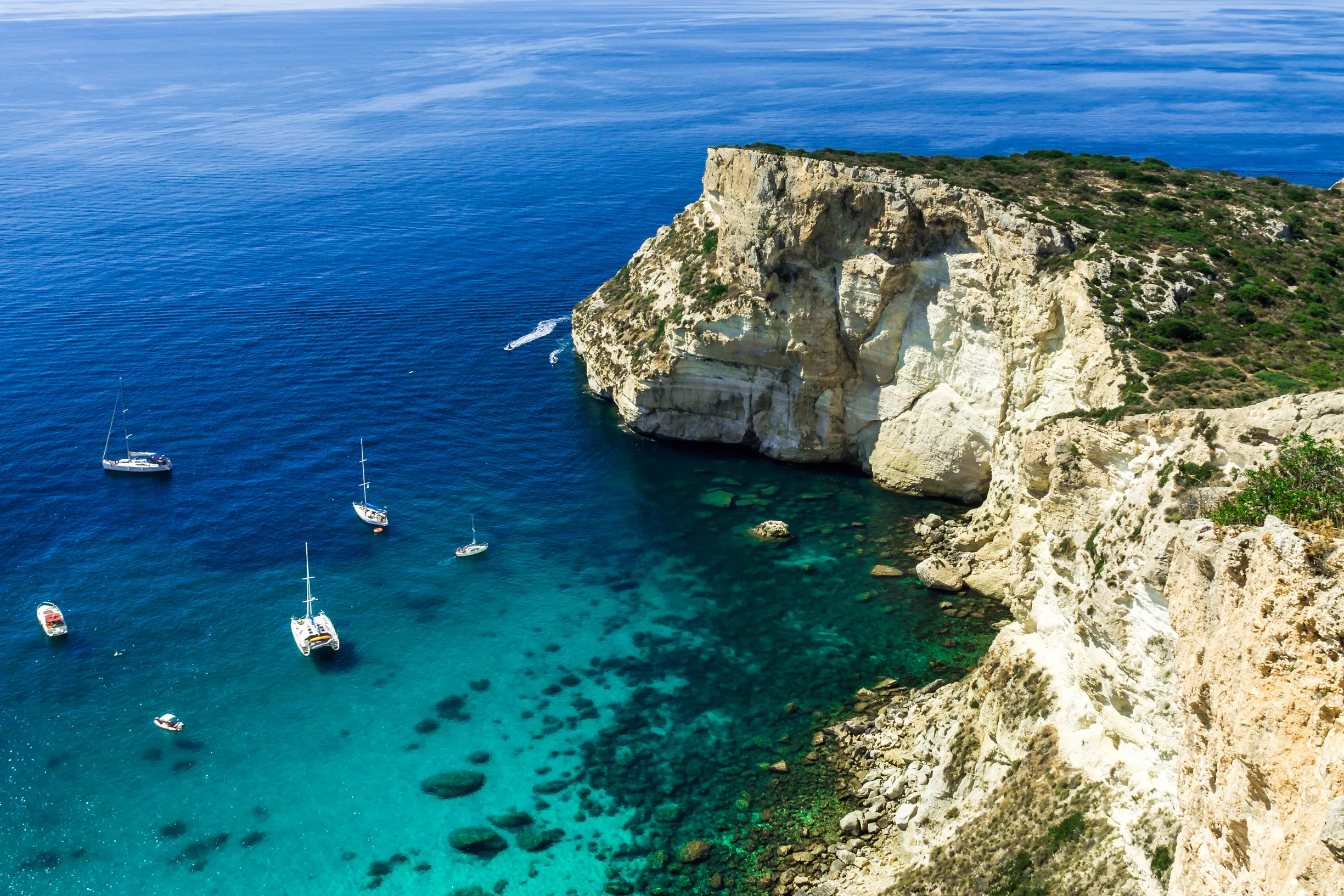
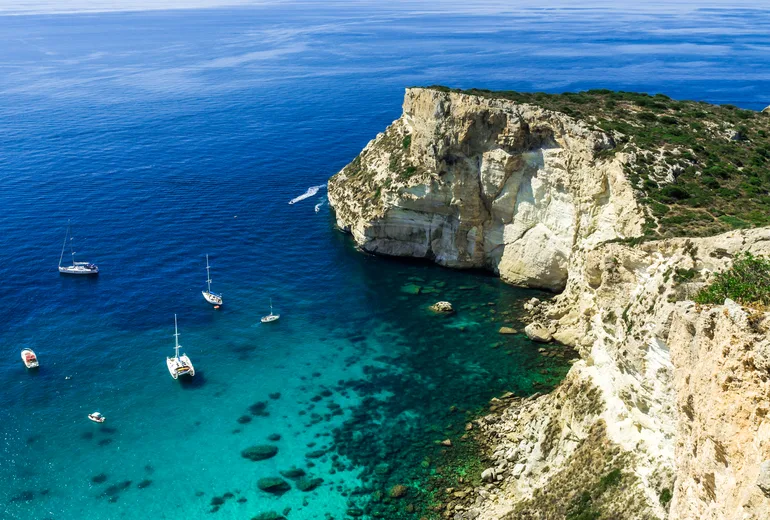
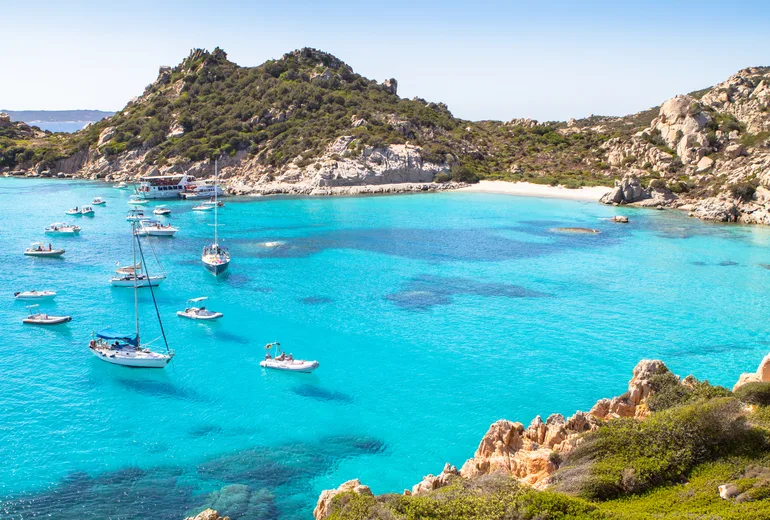
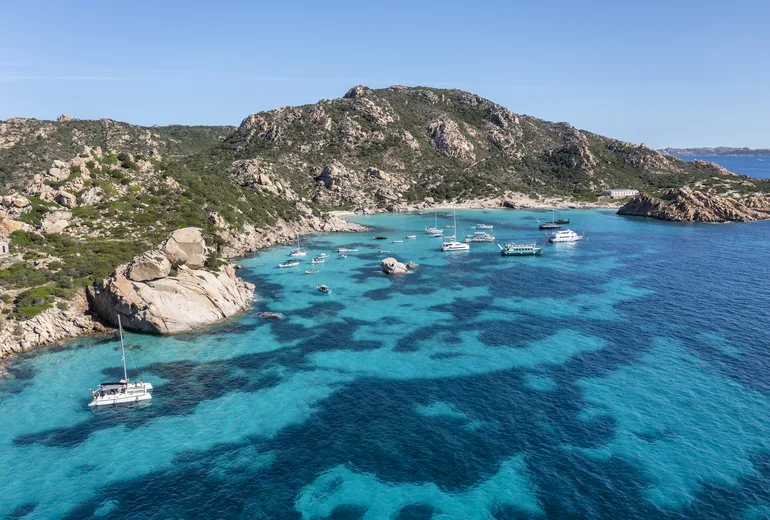
Calm water and short hops win with mixed ages. Sardinia’s La Maddalena archipelago is ideal — sheltered granite coves, white-sand beaches the kids can wade to, and gentle distances between stops. Sicily’s Aeolian Islands work well too, with reliable anchorages off Lipari and Salina and a smoking volcano to keep teenagers interested. The Amalfi Coast is spectacular but busier and more exposed, better suited to a crewed boat that handles the logistics.
Day length matters as much as the destination. With a four-year-old and an eighty-year-old aboard, three hours of sailing is plenty before someone’s restless or stiff, so favour regions where the next anchorage is rarely more than 10–15 NM away. That rules in the Aeolians and La Maddalena and rules out the long, exposed legs of a coastal passage. Plan a couple of full lay days too — a quiet bay where the kids can swim off the steps and the grandparents can read in the cockpit shade does more for crew morale than another spectacular town.
Whatever the region, the boat that fits all three generations is the limiting factor, not the route. Which brings us to the booking timeline.
Here’s the planning reality: every base holds only a handful of five- and six-cabin catamarans, and large family groups book the furthest ahead because coordinating that many people forces early dates. The result is that the genuinely multigen-friendly boats — the ones with the cabin count and the safety layout — are reserved nine to twelve months out for July and August. By spring, you’re choosing from leftovers.
If a 2027 family trip is forming, lock the boat before the route. Confirm the layout, the berth count and the safety kit first; the itinerary can flex around an available cat far more easily than the other way round. Our overview of 2027 Italy charter booking tracks when the larger boats open and how fast they go.
For a typical group of six to eight, a four-cabin catamaran is the baseline — each couple or pair gets a double and the children share. Larger clans of eight or more need a five- or six-cabin boat, which are scarce and book earliest.
The full-hull owner suite is wonderfully comfortable for elders, but it sacrifices a cabin, so it only suits smaller multigen groups of five or six. If your headcount is higher, a standard four- or five-cabin layout sleeps everyone without the luxury of the single suite.
Many families do, even with a licensed member aboard, because it lets the parents focus on the kids and elders rather than running the boat. Adding a hostess or cook removes the chores entirely and tends to be the difference between a relaxing holiday and a busy one.
Nine to twelve months for July and August, particularly for the larger five- and six-cabin catamarans that big family groups need. These boats exist in small numbers at each base and are the first to disappear, so early commitment is the only reliable way to secure the right layout.
Planning a 2027 family trip? Tell us your headcount and dates, and we’ll match you to the right layout on our Italy catamaran charter destinations page before the big boats are gone.
Your privacy
You can read more about how we protect your personal data and use cookies in our Privacy Policy.
With your consent, we and Google use cookies and similar technologies to store and access information on your device and to process personal data such as your visit to this website, your IP address and cookie identifiers. You can withdraw your consent at any time through “Cookies” at the bottom of every page.
We and Google process data for:
Website analytics and visit statistics, recordings of visits to improve the website, ad measurement and remarketing, storing and accessing information on your device